
ADARx Technology

At ADARx, we leverage our innovative technology to design targeted siRNA therapeutics capable of addressing a broad range of diseases. Our siRNA therapeutic candidates are designed to address the challenges of targeted delivery by utilizing a highly modular, compact, and versatile configuration. By assembling distinct, highly engineered components through our proprietary technologies, we design our therapeutic candidates to achieve potent, durable and highly specific mRNA silencing.
The foundational elements of our therapeutic candidates include:
- Double-stranded siRNA: Utilizing our MST technology, our highly optimized, proprietary siRNA are designed to engage RNA-induced silencing complex (RISC) to catalyze precise, efficient and durable cleavage of the target mRNA.
- Targeted delivery component: Powered by our proprietary CTD technology, this component utilizes engineered ligands to trigger selective uptake in targeted cell types. Our modular architecture can be efficiently adapted to a variety of tissues, cell types and therapeutic targets.
- Optional modifiers: As needed, our siRNA therapeutic candidates may include molecular conjugates designed to further optimize pharmacokinetics and pharmacodynamics (PK/PD) profiles and expand the therapeutic window.
Our next-generation technologies allow us to design siRNA therapeutic candidates for potency, precision and durability. By selectively silencing disease-causing proteins, ADARx’s therapeutic candidates are designed to be long-lasting and life-changing treatments that disrupt the treatment paradigm.
RNAi
Delivery
RNAi is an endogenous process initiated by the Dicer enzyme, which processes double-stranded RNA (dsRNA) into an siRNA duplex. The siRNA oligonucleotide duplex consists of two complementary strands: a sense (or passenger) strand and an antisense (or guide) strand, which are complementary to the target mRNA. A protein complex known as RNA-induced silencing complex (RISC) recognizes the siRNA duplex, and an endogenous nuclease, Argonaute 2 (Ago2), unravels the duplex, discards the passenger strand and retains the guide strand, forming the loaded RISC. Once the siRNA guide strand is hybridized to the target mRNA, the RISC cleaves the mRNA, leading to its degradation and preventing the translation of the mRNA into protein. Unlike antisense oligonucleotides (ASOs), which employ a different mechanism as a single strand construct, siRNAs remain bound to the RISC, silencing multiple mRNA copies, resulting in long-term pharmacodynamics (PD) effects.
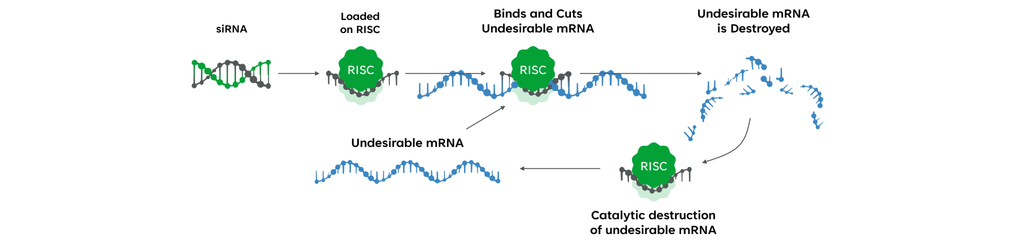
This intrinsic mechanism forms the basis for siRNA therapeutics—medicines designed to selectively silence disease-causing proteins at the molecular level.
ADARx Proprietary MST™ (mRNA Silencing Technology)
Our MST technology includes proprietary software that allows us to identify a unique pool of candidate sequences by taking into consideration the assembly and intrinsic catalytic capability of RISC, while also limiting off-target effects. We then further optimize the siRNA duplex through chemical modifications, tuning kinetics and thermodynamics of siRNA and the resulting RISC, to increase its catalytic activity to repeatedly cleave target mRNA. Our MST technology is designed to generate siRNA therapeutic candidates that provide significant depth and durability of the reduction of the target protein.
Effective siRNA therapeutics require precise delivery to the target tissue or cell type. Without targeted delivery strategies, RNA molecules often fail to efficiently penetrate target cells, leading to lack of effect.
ADARx CTDTM (Cell Targeted Delivery)
Our proprietary CTD technology is designed to enable us to selectively deliver our siRNA therapeutic candidates across a range of organs and disease relevant tissues, including liver (via a novel cluster of GalNAc-derived targeting ligands) and other tissues outside the liver such as adipocytes (obesity), CNS cells (primarily neurons and/or microglia with a proprietary approach utilizing small molecule ligands), skeletal muscle, cardiac muscle and ocular tissues.
Targeting the Liver
We have developed proprietary clusters of N-acetylgalactosamine (GalNAc) ligands, that enable efficient binding to the asialoglycoprotein receptor (ASGPR) highly expressed on liver cells. By incorporating our proprietary GalNAc clusters into our siRNA therapeutic candidates, we designed our therapeutic candidates to have efficient delivery to the liver to increase the depth and durability of clinical response of these therapies directed at hepatic tissues compared to first generation siRNA approaches.
Targeting Outside the Liver
A central challenge in the field of siRNA therapeutics has been the ability to selectively and efficiently deliver drugs to extrahepatic tissues and specific cell types. We believe the next major advancement in the field will be the ability to efficiently deliver siRNA therapeutics to distinct cell types and tissues beyond the liver, including adipose, neurons, microglia, skeletal muscle, cardiac muscle and ocular tissues. Leveraging our proprietary targeting technology, CTD, we seek to expand the therapeutic reach of siRNA therapeutics across a wide range of diseases.
